Make or Buy: How to make the right decision for your IoT communication

Buy smart. Deliver faster.

Rely on proven expertise to shorten your time-to-market.

Are you currently deciding whether to develop a complex software solution in-house or to buy it? The “make or buy” decision can be one of the most critical strategic choices for your business.

This is especially true for embedded software development, where questions quickly arise: Should you build internal expertise? Are your development resources being used for true market differentiation? Or is it smarter to license a proven solution from specialists?

Here’s why buying a specialized software solution is often the better choice – for faster market entry, cost transparency, scalability, and the freedom to focus on your core competencies.

Thumbnail illustrating the comparison between buying a software solution and developing it in‑house

Save time and ressources

Developing embedded software demands highly specialized knowledge and considerable resources. To stay ahead of the competition, your time to market must be short. Focus on building your product – we’ll provide the right software. By licensing pre-validated software, you drastically reduce your product’s development timeline.

Access to expert knowledge

As a specialized provider of protocol stacks, we have many years of experience and in-depth expertise in the development of embedded software. As an active participant in the relevant alliances (e.g., LoRa Alliance, mioty Alliance, OMS Group), our experts are at the cutting edge of developments. This ensures high-quality, reliable, and future-proof solutions.

Cost transparency and control

In-house development often involves hidden costs – extended timelines or unexpected resource needs. Standardized software gives you clear licensing models, predictable pricing, and avoids costly detours – giving you full control over project costs.

Scalability and flexibility

Our solutions are easy to scale and adapt – whether you’re adding features, switching to a new hardware platform, or adjusting to market changes. A reliable partner keeps your investment future-proof.

Assured quality

Our protocol stacks undergo rigorous unit, module, and application testing to guarantee software quality. They’re also pre-certified through official certification tools – a key step toward product certification and interoperability assurance.

Focus on your core business

Outsourcing protocol stack development gives you room for innovation. While we handle the embedded software, your team can focus on products, applications, and business models – where your real competitive advantage lies.

Not convinced yet?

We answer your questions

1. How long does it take to get a protocol stack?

That depends on whether your desired product is already available as an off-the-shelf solution for your target hardware. If so, delivery is quick. If customization or a new development is needed, we’ll discuss your project in detail and provide a clear timeline.

Our standard stack portfolio includes solutions based on common LPWAN technologies like LoRaWAN®, mioty®, and M-Bus (Wireless and Wired) based on OMS specifications.

Yes! Our multi-stack approach allows you to combine several radio technologies on one hardware platform:

  • Redundancy for increased reliability
  • Interoperability in mixed network environments
  • Reduced memory footprint through optimized architecture

Absolutely. In addition to standard solutions, we offer custom extensions or full-stack developments for specific use cases or new technology combinations.

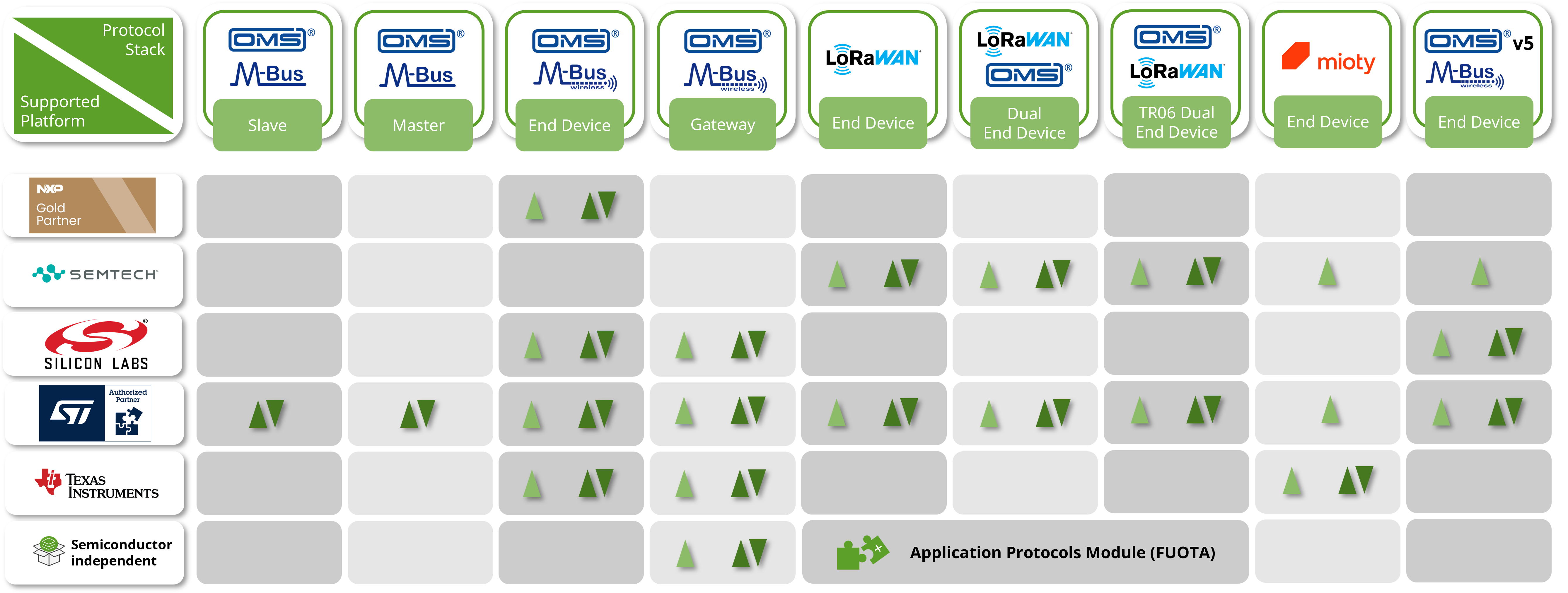
Our software is available for various platforms from leading semiconductor vendors such as NXP, Semtech, Silicon Labs, STMicroelectronics, and Texas Instruments.

We’ll check compatibility with your hardware. If your platform meets minimum requirements, stack porting is generally possible. We’re happy to estimate the effort – or provide our Porting Guide if you prefer to handle it yourself.

That depends on complexity. Once we align on requirements, we’ll create a project plan with milestones and timelines.

You’ll get everything needed for integration:

  • Precompiled stack library
  • Hardware-specific drivers
  • Serial interface (UART, SPI, etc.)
  • Power management
  • Example applications
  • Complete documentation

The protocol stack itself is delivered as object code and cannot be modified directly. However, the platform interface (HAL and RF driver integration) is provided as source code. This lets you:

  • Adapt the driver to your hardware
  • Configure radio settings
  • Optimize performance
  • Integrate your own modules (e.g., security or timing)
    For deeper changes, we offer custom development services.

Yes. We offer maintenance contracts, regular updates, and direct support from our developers in addition to licensing.

Prices vary based on licensing model. A general cost overview and details on our licensing options can be found in the License Overview.

Yes. You can request a free evaluation license and test the software in your environment – no obligation, no risk.

Explore related Topics and Insights

LinkedIn Icon for STACKFORCE LinkedIn channel

More News on LinkedIn

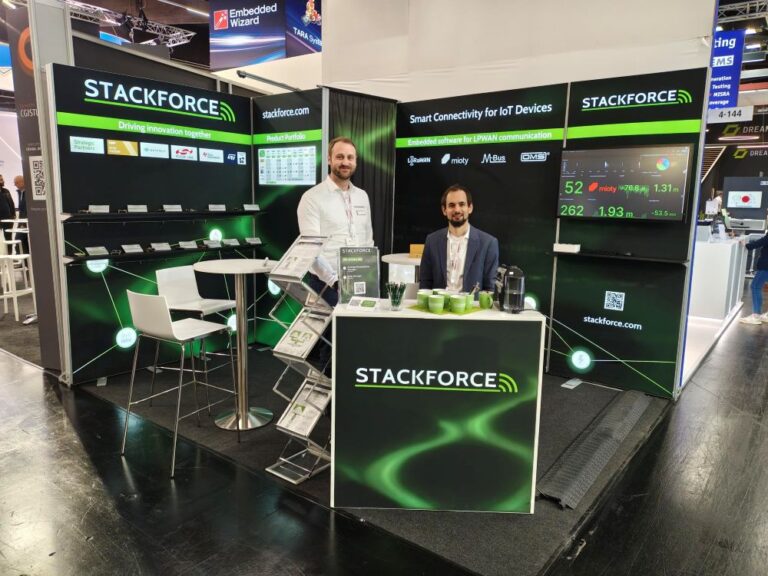
Thumbnail illustrating the STACKFORCE booth at embedded world 2025 with STACKFORCE staff
STACKFORCE at embedded world 2025 – A look back at an incredible event
embedded world 2025 was a great success for STACKFORCE, showcasing live demos, expert insights and our latest product innovations. From wireless communication technologies to FUOTA, we presented future-ready solutions that drive the embedded industry forward.
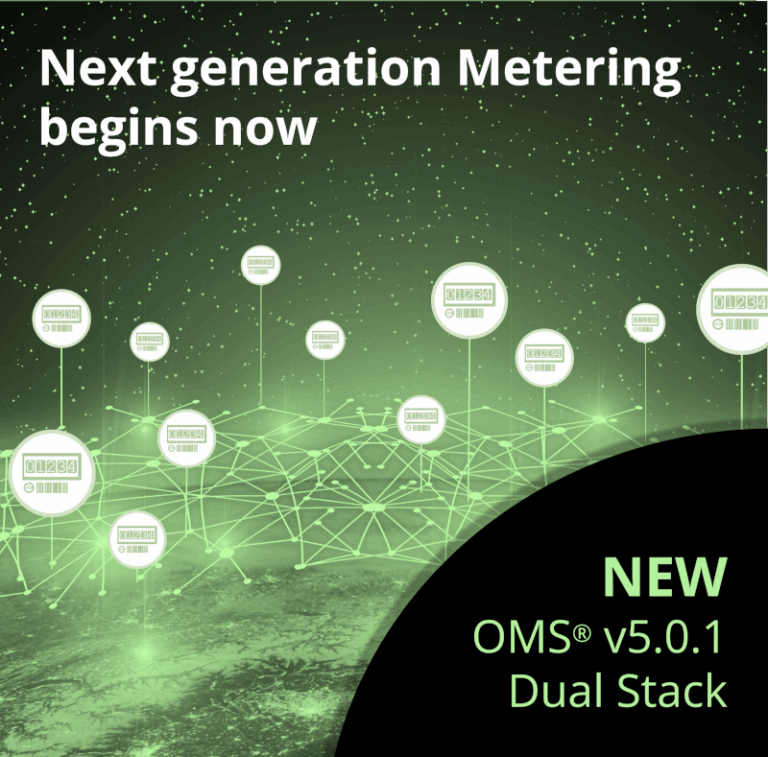
Thumbnail illustrating OMS® v5.0.1 Dual Stack as the next generation metering solution combining advanced OMS and LPWAN capabilities
New product: OMS® v5.0.1 Dual Stack now available
STACKFORCE launches the new OMS® v5.0.1 Dual Stack – combining LPWAN UL-S1/S2 and Wireless M-Bus C1 for maximum interoperability, extended range, and future-proof smart metering.
Thumbnail symbolizing smart agriculture with connected sensors and data‑driven farming
Smart Agriculture: Efficiency and sustainability through digital farming technologies
Modern agriculture faces enormous challenges: rising demand, increasing weather extremes, limited resources, growing water scarcity, and intense price pressure. At the same time, markets and society demand greater transparency, sustainability, and efficiency.
Thumbnail illustrating smart industry use cases with connected industrial automation systems
Smart Industry: Robust communication for harsh industrial environments
Connected supply chains and mobile assets demand full transparency and agility. IoT-driven solutions using LPWAN technologies enable energy-efficient, scalable monitoring and control of transport and warehouse processes - anytime, anywhere. This makes smart logistics the foundation for global markets and just-in-time production.