In modern IoT applications, flexibility and responsiveness are essential.
What is a Multi‑Protocol Stack?
A multi‑protocol stack combines several communication stacks within a shared software architecture. Depending on the application, the appropriate protocol can be selected manually or automatically — even during live operation. Whether LoRaWAN®, mioty® or Wireless M‑Bus (OMS®): multi‑protocol solutions allow seamless switching or simultaneous operation of multiple technologies within a single device.
Architecture & Chip Design: Multi‑Protocol on one MCU
One Chip vs. two Chip Design
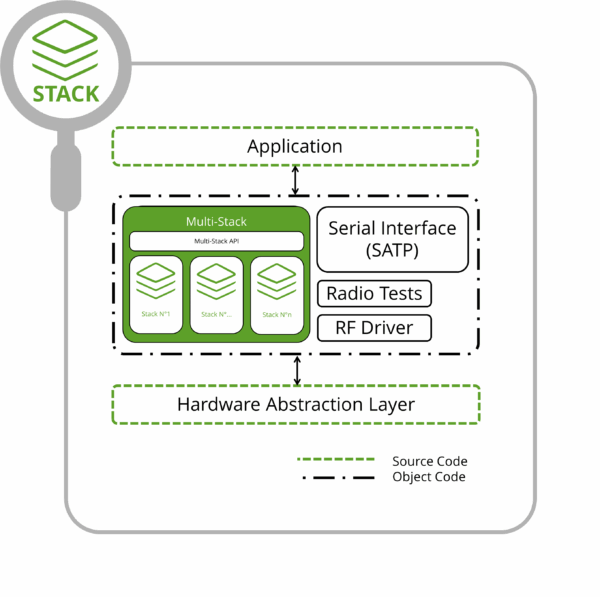
STACKFORCE Multi Stacks support both single‑MCU (one‑chip) and MCU + communication controller (two‑chip) architectures.
- One‑chip advantages: lower cost, less board space, easier integration
- Important consideration: running multiple protocols simultaneously requires more memory — careful planning is essential
Multi Stack API: Switching, prioritization & control made simple
A key feature of the STACKFORCE Multi Stack is its intelligently designed API, offering a unified interface to control all integrated protocols.
The API supports:
- Parallel operation of multiple protocols on one MCU (if technically compatible)
- Time‑based, event‑based or condition‑based switching
- Custom switching strategies, such as:
- Condition-based: switch when signal is lost, battery low or network unavailable
- Priority‑based: protocol X overrides Y under defined conditions
- Time‑slot‑based: different protocols used at scheduled intervals
All logic can be dynamically adjusted at runtime — fully controlled via the API.
Easy migration from Single to Multi Stack
Already using a STACKFORCE Single Stack?
Migrating to a Multi Stack is straightforward:
- Replace the existing Single‑Stack library with the Multi‑Stack library
- Extend your application logic to address the additional protocols
Benefits at a gance
- Improved network coverage
- Higher flexibility and extended communication range
- Lower integration effort
- More efficient use of hardware resources
- Ideal for both mobile and stationary applications
Multi‑protocol solutions are the answer to heterogeneous communication environments and complex IoT requirements.
Real‑World application examples
Smart Metering: Local + Remote in One Device
Wireless M‑Bus enables “walk‑by” or “drive‑by” local metering. A Multi‑Protocol Stack adds LoRaWAN® or mioty® as an LPWAN option — enabling automated, long‑range data transfer without manual effort.
A single device can therefore support both stationary and mobile reading scenarios.
Mobile Assets: Always Connected
Example: A brewery tracks its beer kegs using integrated sensors.
- On company grounds: data is sent via LoRaWAN®
- Off-premises: Sigfox takes over via public network
- Returned to site: communication automatically switches back
Perfect for mobile tracking and logistics.
When is a Multi‑Protocol Stack the right choice?
A multi‑protocol solution is usually the most future‑proof option — especially when flexibility, scalability and reach are crucial.
For applications with very tight memory constraints, a single‑protocol stack may be more suitable.
Our recommendation:
Plan ahead. Choosing a Multi Stack early allows you to leverage the strengths of multiple technologies from the start. Interested in whether a Multi‑Protocol Stack fits your project? We are happy to advise — openly, neutrally and vendor‑independent.