What are Protocol Stacks – And why are they essential for digitalization?

In the digital world of Smart Metering, Smart Industry, Smart Agriculture and Smart Cities, software‑driven process automation is becoming indispensable. At the heart of this automation lies an often invisible yet critical component: the Protocol Stack.

A protocol stack is specialized communication software that enables devices—such as sensors, meters or gateways—to transmit data wirelessly. In simple terms, it “teaches” a device how to communicate. The software is structured into layers, each responsible for a specific function, such as radio access, data formatting or addressing. This layered design is what gives the protocol stack its name — a stack of communication protocols.

A protocol stack runs silently on a device’s microcontroller and communicates via a radio transceiver or integrated RF interface. Using technologies such as LoRaWAN®, mioty® or Wireless M‑Bus (OMS®), it transmits data to a central IoT system. This allows operational states and processes to be monitored over long distances and evaluated at predefined intervals.

Thumbnail illustrating the release of a protocol stack for additional hardware platforms, symbolizing cross‑platform compatibility

Why Protocol Stacks matter

Protocol stacks form the backbone of device connectivity and automated workflows. They enable sensors, machines and measurement devices to communicate autonomously — without human intervention.

This unlocks key benefits:

  • Reduced manual work (e.g. remote meter reading)
  • Increased safety via remote maintenance
  • Early detection of faults or wear
  • Better resource planning and utilization
  • Centralized monitoring of complex infrastructures
  • New business models enabled by smart digital services

Whether in large industrial facilities or small smart‑home setups: protocol stacks enable reliable, scalable data communication across virtually all IoT environments.

Buy or develop? A strategic decision

Many companies face the same question: Should we build our own protocol stack or purchase one?

While STACKFORCE naturally provides ready‑made solutions, there are many objective reasons why buying a proven protocol stack is often the better option:

Advantages of ready-to-use protocol stacks
  • Immediately deployable — no multi‑year development effort
  • Proven & stable — tested across countless real‑world applications
  • Predictable costs thanks to transparent licensing
  • Support included — technical assistance, updates & maintenance
  • Always up to date — new standards and features integrated continuously
  • Customizable — individual extensions and features can be added

For companies focused on their core business, purchasing a professional protocol stack is both economically efficient and risk‑reducing.

STACKFORCE Protocol Stacks – Reliable, modular, ready to use

As an expert in IoT communication software, STACKFORCE offers a broad portfolio of standard protocol stacks and flexible multi‑stack solutions.
Whether you need a single‑stack for a specific project or a multi‑protocol solution for maximum flexibility — all STACKFORCE products are:

  • directly integrable
  • platform‑independent
  • modular and scalable
  • easy to maintain and update

Our standard stacks are perfect for fast project starts: off‑the‑shelf, ready to integrate, and thoroughly tested.
For applications requiring deeper customization, we offer Custom Solutions tailored precisely to your functional and architectural requirements — in close cooperation with your development team.

Our Product highlights

OMS® v4.5.1 / wM-Bus for End Devices

Single Stack

End Device

Available for: NXP, Silicon Labs, STMicroelectronics

Compliant with standards (EN 13757 / OMS®)

Pre-certification for reference hardware

Energy efficient & low complexity

Uni- and bidirectional communication

OMS® v4.5.1 / wM-Bus for Gateways

Single Stack

Gateway

Available for: Silicon Labs, STMicroelectronics

Compliant with standards (EN 13757 / OMS®)

Pre-certification for reference hardware

One gateway serves 20 end devices.

Uni- & bidirectional communication

OMS® v5.0.1 LPWAN UL-S1/S2 + wM-Bus C1 for End Devices

Multi Stack

End Device

Available for: Silicon Labs

Compliant with standards (EN 13757 / OMS®)

Pre-certification for reference Hardware

Excellent robustness thanks to splitting mode

Greater range compared to OMS® v4

LoRaWAN® v1.0.4 for End Devices

Single Stack

End Device

Available for: STMicroelectronics

LoRaWAN® Specification v1.0.4

Efficient industrial use

Tested in industrial IoT applications worldwide

Pre-certification for reference hardware

mioty® v1.1.1 for End Devices

Single Stack

End Device

Available for: STMicroelectronics, Texas Instruments

ETSI-Norm TS 103 357 TS-UNB v1.1.1

Innovative Telegramm-Splitting-Technology

Up to 1.5 million messages/day per gateway

Pre-certification for reference hardware

OMS®/wM-Bus + OMS® over LoRaWAN® for End Devices

Multi Stack

End Device

Available for: Semtech, STMicroelectronics

Seamless switching between stacks

Two types of remote meter reading

Integration of LoRaWAN® into the OMS® world

Pre-certification for reference hardware

Explore related Topics and Insights

LinkedIn Icon for STACKFORCE LinkedIn channel

More News on LinkedIn

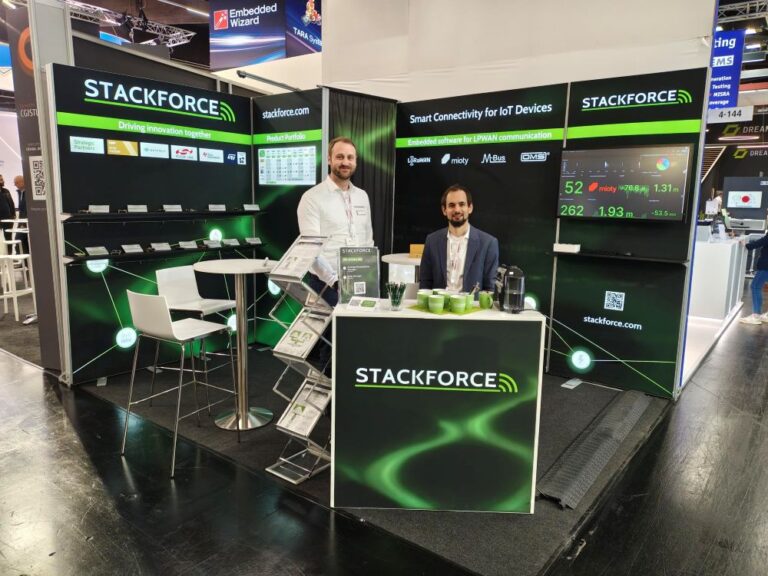
Thumbnail illustrating the STACKFORCE booth at embedded world 2025 with STACKFORCE staff
STACKFORCE at embedded world 2025 – A look back at an incredible event
embedded world 2025 was a great success for STACKFORCE, showcasing live demos, expert insights and our latest product innovations. From wireless communication technologies to FUOTA, we presented future-ready solutions that drive the embedded industry forward.
Thumbnail illustrating OMS® v5.0.1 Dual Stack as the next generation metering solution combining advanced OMS and LPWAN capabilities
New product: OMS® v5.0.1 Dual Stack now available
STACKFORCE launches the new OMS® v5.0.1 Dual Stack – combining LPWAN UL-S1/S2 and Wireless M-Bus C1 for maximum interoperability, extended range, and future-proof smart metering.
Thumbnail symbolizing smart agriculture with connected sensors and data‑driven farming
Smart Agriculture: Efficiency and sustainability through digital farming technologies
Modern agriculture faces enormous challenges: rising demand, increasing weather extremes, limited resources, growing water scarcity, and intense price pressure. At the same time, markets and society demand greater transparency, sustainability, and efficiency.
Thumbnail illustrating smart industry use cases with connected industrial automation systems
Smart Industry: Robust communication for harsh industrial environments
Connected supply chains and mobile assets demand full transparency and agility. IoT-driven solutions using LPWAN technologies enable energy-efficient, scalable monitoring and control of transport and warehouse processes - anytime, anywhere. This makes smart logistics the foundation for global markets and just-in-time production.