
We enable reliable communication between devices.
Home › Protocol Stacks – good to know
Protocol stacks are more than just “a piece of software.” They are highly specialized, modular software components essential for communication in the Internet of Things (IoT).
In simple terms: A protocol stack is the software foundation of any connected communication – without it, devices don’t speak the same language.
This page provides a practical introduction to the topic – tailored for those who want to quickly and clearly understand what protocol stacks do, why they are indispensable for IoT, and what to consider when choosing one.
STACKFORCE is a leading provider of embedded software and a specialist in protocol stacks for the IoT. Our software enables standardized, secure, and efficient communication in smart devices – in areas such as Smart Metering, Industry 4.0, Smart Cities, and more.
A protocol stack enables IoT devices like sensors, meters, or gateways to communicate. The stack forms the basis for transmitting and receiving data. The term “stack” describes its layered structure – similar to a building where each floor has a defined function in communication.
A protocol stack is the communication backbone of any IoT device. It enables and manages device communication based on defined rules (protocols).
A protocol stack:
Protocol stacks target automation of formerly manual, often operational processes. They can be adapted to a wide range of use cases:
STACKFORCE develops protocol stacks for leading and future-proof technologies, including:
Yes – STACKFORCE offers multi-stacks that combine multiple wireless protocols.
Benefits:
In principle, an optimized stack integrated into your products shortens your own product development time, reduces certification effort, and simplifies scaling.
Additional benefits – tailored to your requirements:
A flexible, pre-certified stack is crucial for fast and smooth product launches. It offers standardized communication, reduces testing effort, and ensures interoperability in various markets and infrastructures.
Other benefits at a glance:
We’re here to discuss your project and offer tailored support wherever you need it.

A protocol stack package contains all necessary components to use the stack flexibly in different system architectures. Included in the delivery are:
Example: This app serves as a template for integrating the protocol stack into your own firmware. It shows how the stack library can be embedded directly into application software – ideal for single-chip designs.
Modem: This app enables you to develop your own modem firmware using the supplied serial interface and power management – especially suitable for two-chip designs.
There are three different approaches:
Use of an external communication module
The communication module handles all radio communication. It is connected to the existing sensor hardware via interfaces like UART or SPI – without major changes to electronics or housing.
Three variants are possible:
Development of your own firmware using the protocol stack as a library
Advantage: Low integration effort and easier certification
Integration in two-chip design
In this approach, communication is handled by a separate microcontroller or SoC, while the application runs on a host controller. The protocol stack runs on the communication controller, usually using the supplied modem app.
Advantage: Good balance between integration and flexibility
Note: Slightly higher hardware effort, as a dedicated board is required
Integration in single-chip design
Here, application and protocol stack run together on one microcontroller. The stack is integrated as a software library directly in the firmware. This solution is especially suitable when space and cost are critical.
Advantage: Minimal hardware cost and smallest footprint
Disadvantage: Higher development effort and possibly more complex hardware design
STACKFORCE supports you with architecture selection, porting, and testing.
STACKFORCE stacks are designed hardware-independent and basically compatible with any hardware.
Requirements:
We collaborate with leading semiconductor manufacturers like NXP, Semtech, Silicon Labs, STMicroelectronics, and Texas Instruments and have “off-the-shelf” standard stacks available for many hardware platforms.
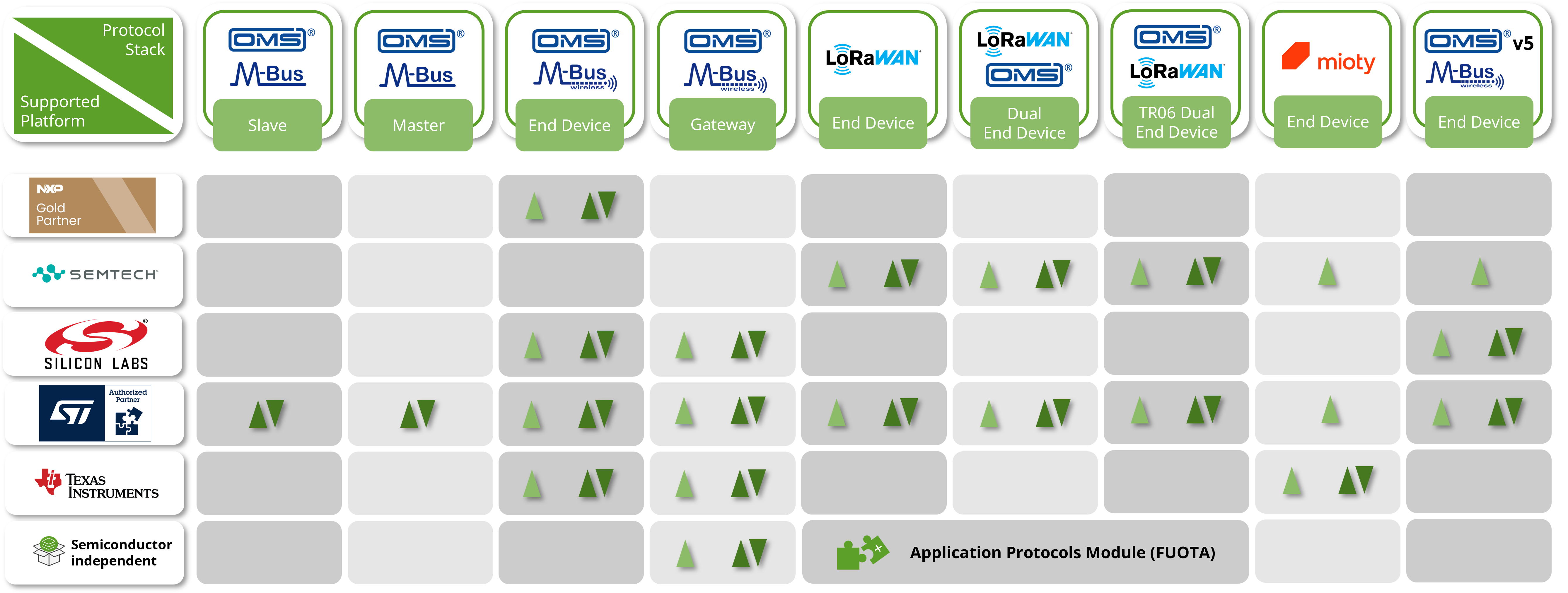
Typical challenges are:
STACKFORCE addresses these with comprehensive consulting, proven porting methods, and test automation. Thinking of developing stacks internally? Check out our decision guide on build vs. buy!
STACKFORCE accompanies customers comprehensively – from initial consulting to production-ready solutions: